Soccer Passing Drills From Kneeling to Standing to Layer Complexity Gradually
You start on your knees to eliminate leg swing and sharpen first-touch precision, making clean control non-negotiable. This builds technical discipline before progressing to standing passing, where movement adds timing and spatial demands. Gradually layer in defenders to stress decision-making, then shift to small-sided games that test accuracy under fatigue. Each phase magnifies real-game execution-master these stages and you’ll see how seamless passing under pressure unfolds.
Notable Insights
- Begin with passing drills from the knees to eliminate momentum and emphasize precise foot placement and first touch control.
- Use kneeling positions to enhance technical discipline, forcing accurate cushioning and proper foot angle during reception and release.
- Transition to standing passing drills with movement, integrating dynamic footwork, angle adjustment, and timing for realism.
- Introduce passive and active defenders to simulate pressure, sharpening decision-making, shielding, and quick release under constraints.
- Apply skills in small-sided games to replicate match conditions, building passing accuracy, awareness, and composure under fatigue.
Start on Knees to Sharpen First Touch and Accuracy
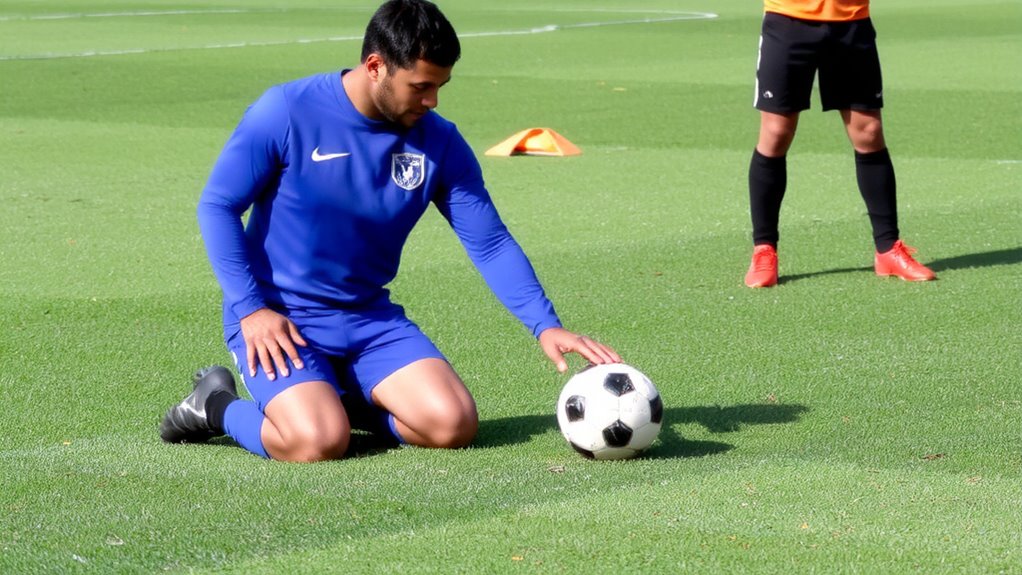
Your teammate’s pass isn’t just a test of timing-it’s a demand for precision, especially when drills start on knees to emphasize control over power. This setup forces you to focus on your first touch, turning a simple reception into an act of deliberate placement. Without the momentum of your legs, you can’t rely on strength, so accuracy becomes non-negotiable. You learn to angle your foot just right, cushioning the ball softly to maintain possession. It’s not just repetition-it’s refined repetition. Performing these drills consistently sharpens spatial awareness and technical discipline. The feedback is immediate: a misplaced touch rolls too far, a rushed return lacks direction. You begin to recognize how body alignment affects outcome. Over time, this translates to cleaner receiving and smarter distribution in live play. Starting on knees isn’t regression-it’s reengineering your instincts for better control and accuracy under constrained conditions.
Practice Passing From Knees for Cleaner Control
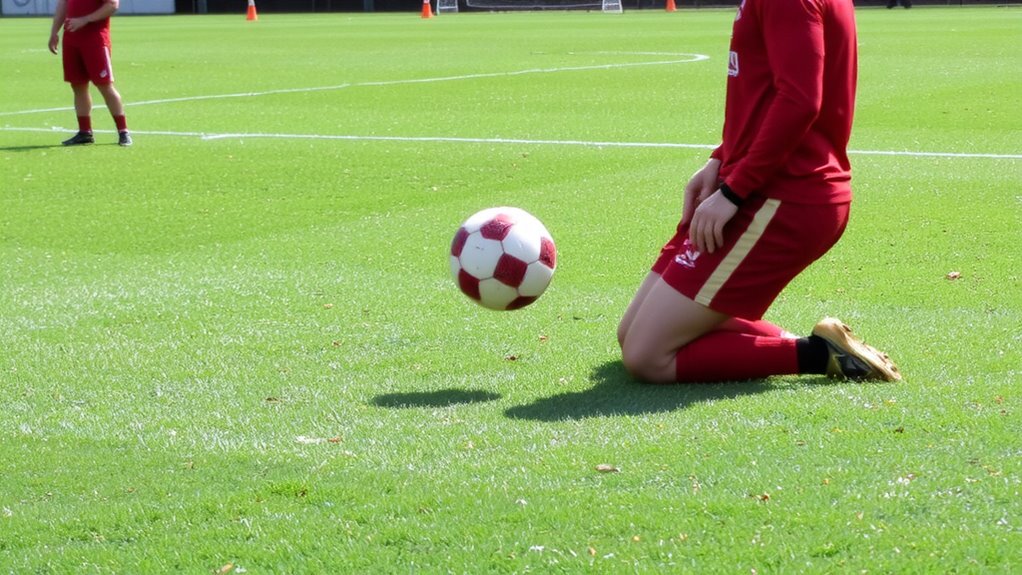
A drill that begins with players on their knees isn’t a regression-it’s a strategic reset designed to strip away muscle memory and force technical precision. You stabilize your upper body, which sharpens your awareness of foot placement and weight transfer. Without the ability to lunge or overstride, you’re compelled to focus on clean contact, improving both passing precision and ball control. Your first touch becomes more consistent because you can’t rely on momentum to mask errors. Partners feed passes at varying speeds, and you return them using inside-of-the-foot technique, ensuring accuracy under subtle pressure. This limited mobility heightens neuromuscular feedback, making corrections immediate and lasting. Coaches observe clearer technical flaws when players are on knees-hips misaligned, ankles loose-allowing real-time adjustments. Though static, the drill builds foundational control essential for dynamic play. You’ll notice tighter touch and crisper delivery once you stand, proving that controlled restriction accelerates mastery more than unstructured repetition ever could.
Add Movement With Standing Passing Drills
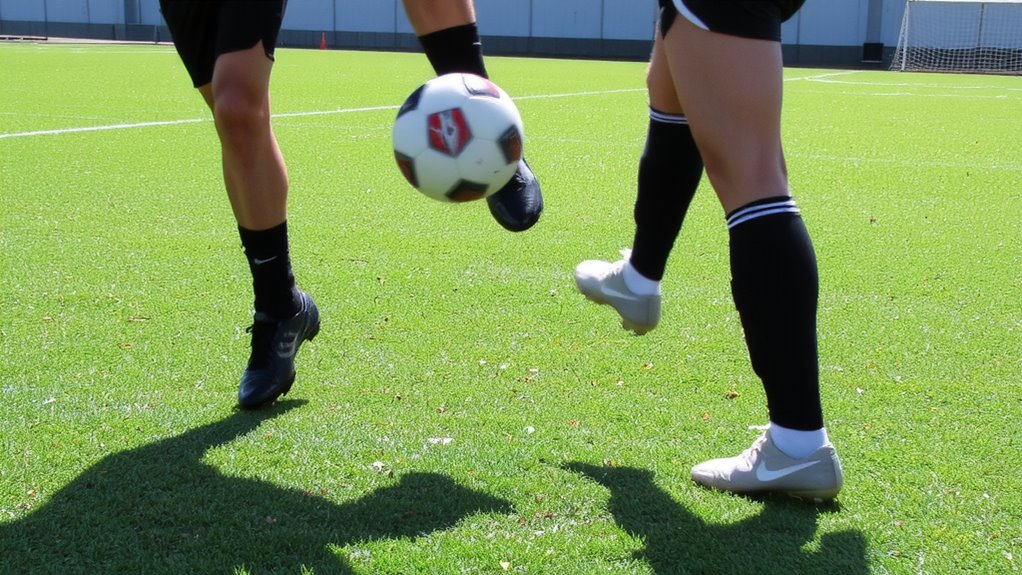
Passing on the move isn’t just an upgrade from static drills-it’s where technique meets real-game demands. Now you’re blending dynamic movement with accuracy, forcing your body to adjust while maintaining clean touches. Standing passing drills with motion sharpen your spatial awareness, helping you read angles and time passes under realistic conditions. You’ll start to anticipate where teammates will be, not just where they are.
| Drill Type | Focus Area | Benefit |
|---|---|---|
| Zig-zag passes | Footwork & timing | Enhances coordination |
| Overlapping runs | Dynamic movement | Builds rhythm in buildup |
| Triangle passing | Spatial awareness | Sharpens positioning |
| One-touch on the move | Speed & precision | Simulates high-tempo play |
These drills bridge control with realism, making your passing smarter and more adaptable during actual match scenarios. You’re not just moving-you’re thinking and connecting.
Introduce Defenders to Pressure Passing Decisions
What happens when the drill stops feeling like repetition and starts mirroring the stress of a closing defender? You’re forced to think faster, move smarter. Introducing passive then active defenders shifts the dynamic completely. Suddenly, your passing isn’t just about accuracy-it’s about survival. Pressure shifts now dictate your options, compressing time and space. You’ve got to read the angle of approach, anticipate interference, and adjust before it’s too late. Decision timing becomes critical; even a half-second delay results in a turnover. Positional awareness sharpens as you learn to shield, pivot, or release under tension. Defenders don’t need to win every ball-just close fast enough to disrupt rhythm. This stage builds real-game instincts, bridging technical control with mental agility. The right spacing and progressive intensity guarantee players adapt without breaking form. You’ll notice sharper reads, quicker releases, and smoother shifts under duress-exactly what effective possession demands.
Play Small-Sided Games to Apply Passing Under Fatigue
When you’ve pushed through repeated drills and your legs start to feel heavy, that’s exactly when small-sided games become most valuable. These games simulate real match conditions, forcing you to make sharper decisions under fatigue. By reducing player numbers-like playing 3v3 or 4v4-you increase touches and intensity, amplifying game dynamics in a condensed space. This environment challenges your ability to read movement, time passes, and manage energy. Importantly, it teaches fatigue management not just physically, but cognitively-your brain stays sharp when your body doesn’t. You learn to maintain technique and composure even as exhaustion sets in. Unlike isolated drills, small-sided games demand constant adaptation, enhancing your fitness recovery resilience over time. The gear you wear-compression sleeves, moisture-wicking fabrics-supports muscle response and endurance, but real adaptation comes from play. It’s where passing precision meets real-world demand.
Run Game-Speed Passing Sequences for Real Match Rhythm
Though you might master passing in static drills, real match rhythm only emerges when sequences unfold at game bruising, demanding sharper timing and coordination. You’ve got to replicate the pace and pressure of actual play, where split-second decisions dictate success. Running game-speed passing sequences trains your body and mind to handle rapid ball rotation, mimicking shifts you’ll face in competition. Spacing patterns become critical here-players must constantly adjust angles and distances to stay connected under movement. You’ll notice how off-the-ball runs create passing lanes and how tight marking disrupts timing. This drill sharpens awareness, forcing everyone to anticipate, not react. When executed with urgency, these sequences expose weaknesses in decision-making and positioning, making them invaluable for high-level prep. Unlike slow-paced reps, this intensity builds neural and physical stamina. Coaches should monitor rhythm and alignment, correcting spacing patterns early to reinforce smart habits and fluid ball rotation throughout.
On a final note
You’ve built precise passing through progressive kneeling and standing drills, then stress-tested decisions under pressure. Now, in small-sided games and full-speed sequences, your first touch and accuracy hold up even when fatigued. This tiered approach sharpens both technique and timing, mirroring real match demands. Consistency, not flash, wins here-drills reinforce neural pathways and muscle memory. Paired with proper recovery and quality gear, like compression wear and durable balls, performance gains stick.