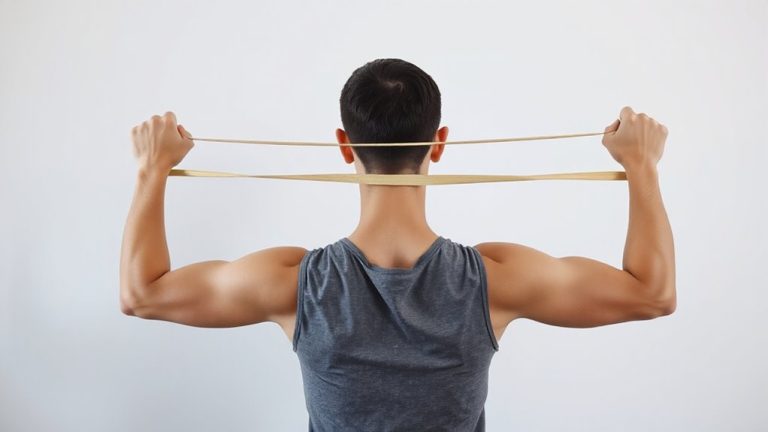
Prehabilitation Exercises for Preventing Low Back Pain in Golfers
You’re at risk for low back pain because golf demands extreme spinal rotation and compressive forces. Strengthen your core with exercises like Dead Bugs and Bird-Dogs to stabilize your spine, while Pallof Press builds rotational control. Improve thoracic mobility with cat-cow stretches and boost hip function using clamshells and lunges. Consistent prehab-just 10 minutes before practice-reduces strain and enhances swing mechanics. A disciplined routine outperforms gear alone, setting the stage for greater gains.
Notable Insights
- Strengthen core muscles like the transverse abdominis and multifidus to enhance spinal stability during rotation.
- Perform Pallof Press exercises to improve rotational control and resist swing-related spinal forces.
- Incorporate Bird-Dog and Dead Bug exercises to boost coordination and support lumbar alignment.
- Use cat-cow stretches and thoracic rotations to maintain spinal mobility and reduce compensatory strain.
- Activate glutes with clamshells and banded walks to stabilize the pelvis and minimize low back load.
Why Golf Causes Back Pain
Golf might look easy on the surface, but that repetitive twisting motion puts serious strain on your lower back. Your swing demands aggressive spinal rotation, often exceeding 90 degrees, which stresses discs and ligaments over time. Combine that with poor posture or stiffness, and you’re setting up for trouble. Each downswing also creates significant joint compression, especially when you lack flexibility or proper mechanics. These forces concentrate in the lumbar spine, where repeated impact can lead to microtrauma or even injury. Fitness recovery tools like foam rollers or targeted mobility gear help manage this, but only if used consistently. The best gear supports spinal alignment and reduces tension, yet it’s no substitute for understanding biomechanics. You need to respect how spinal rotation and joint compression interact during play. Smart training, informed recovery choices, and attention to form make a real difference in longevity. Ignoring these factors risks chronic pain, regardless of recovery equipment quality.
Prevent Back Pain With Core Strength
Most serious golfers who stay pain-free over time share one thing: a consistently trained core. You need more than strength-you need precision. A strong core promotes proper spinal alignment and enhances rotational stability, both critical during your swing. Without these, stress concentrates on the lumbar spine, increasing injury risk. Effective prehab isn’t about heavy gear or flashy tools; it’s consistent, targeted work. Below are foundational exercises proven to build resilient core function:
| Exercise | Focus Area | Benefit for Golfers |
|---|---|---|
| Dead Bug | Transverse abdominis | Improves spinal alignment |
| Bird-Dog | Multifidus | Enhances balance and control |
| Pallof Press | Rotational stability | Counters twisting forces in the swing |
| Plank with Rotation | Obliques | Builds dynamic rotational stability |
| Glute Bridge | Posterior chain | Supports pelvic and spinal alignment |
Your core isn’t just abs-it’s your foundation. Train it wisely.
Free Your Spine for a Safer Swing
Why does your swing feel restricted, even when you’ve warmed up thoroughly? The issue might not be your effort-it’s likely limited spinal mobility. Without adequate movement through your spine, you can’t achieve ideal swing mechanics, forcing other joints to compensate. Over time, this places stress on your lower back, increasing injury risk. Proper spinal mobility allows for smoother rotation, letting you coil and uncoil efficiently during your swing. That means less strain and more power delivered where it counts. Exercises like thoracic rotations and cat-cow stretches aren’t flashy, but they’re proven to enhance segmental motion. Used consistently, they maintain tissue quality and joint function. Unlike passive tools or recovery gear promising quick fixes, these drills directly target mobility deficits. They’re practical, require no equipment, and integrate easily into prehab routines. Prioritize them regularly, and you’ll notice a freer, safer swing that supports long-term performance.
Fuel Your Swing With Strong Glutes and Hips
Power in your swing doesn’t come just from your arms or shoulders-it starts in your glutes and hips, the engine room of rotational force. You need strong glute activation to stabilize your pelvis and transfer energy efficiently through your core to the club. Weak glutes force your lower back to compensate, increasing injury risk. Hip mobility allows full, pain-free rotation during your backswing and follow-through. Limited motion here restricts your range and strains surrounding joints. Exercises like clamshells and banded walks boost glute activation, priming the muscles before play. Dynamic lunges and hip circles improve hip mobility, supporting smoother, more powerful turns. Together, they enhance swing mechanics while protecting your spine. Using resistance bands or foam rollers can aid both strength and flexibility, but consistency matters more than gear. Make these movements part of your warm-up, and you’ll notice better control, more distance, and reduced strain. Strong, mobile hips aren’t just helpful-they’re essential.
Make Prehab Part of Your Golf Routine
You’ve built a solid foundation with strong glutes and mobile hips, but consistency is where real results take hold. Prehab isn’t a quick fix-it’s a long-term investment in injury prevention and performance, which means routine integration is essential. Treating prehab like a warm-up you skip when short on time undermines its value. Instead, schedule it like your swing practice: non-negotiable. Ten minutes before hitting the range can reduce low back strain and improve mechanics. Consistency matters more than duration-daily execution beats occasional intensity. Use simple tools like resistance bands or foam rollers to enhance mobility and recovery, but don’t rely on gear alone. The best equipment supports the process; it doesn’t replace discipline. Track progress through movement quality, not just strength. Over weeks, consistent prehab sharpens stability, eases strain, and reinforces proper mechanics. Make it routine, and your back will thank you. Some athletes also incorporate muscle stimulators to augment recovery and neuromuscular activation between sessions.
On a final note
You’ll prevent low back pain by building core strength, mobile spines, and powerful glutes-key for the golf swing. Prehab isn’t optional; it’s smart training. Exercises like bird-dogs and glute bridges boost stability and reduce injury risk. Consistent integration into your routine improves swing mechanics and longevity. Recovery gear like foam rollers aids muscle release, supporting adaptation. Combined, prehab and proper recovery enhance performance, letting you play stronger, longer.