Building a Customized Rehab Program for Ligament Damage Recovery
You need a clear diagnosis to build your rehab program, since each ligament injury demands specific care. Start with gentle range-of-motion exercises and use compression, bracing, and elevation to control swelling. Once pain drops, add isometric and resistance band exercises to rebuild strength safely. Progress by tracking function and symptoms, not timelines. Proper joint alignment and graded challenges prevent setbacks-keep adapting your plan, and you’ll uncover smarter ways to protect your recovery long-term.
Notable Insights
- Accurately identify the damaged ligament, location, and severity using advanced imaging and professional assessment.
- Set specific short-term and long-term recovery goals to guide structured rehabilitation progress.
- Begin with gentle range-of-motion exercises and controlled movements to promote healing without strain.
- Use supportive tools like braces and compression wraps to stabilize the joint and reduce swelling.
- Progress to gradual strength-building exercises focusing on proper alignment and graded resistance.
Pinpoint Your Ligament Injury and Recovery Goals
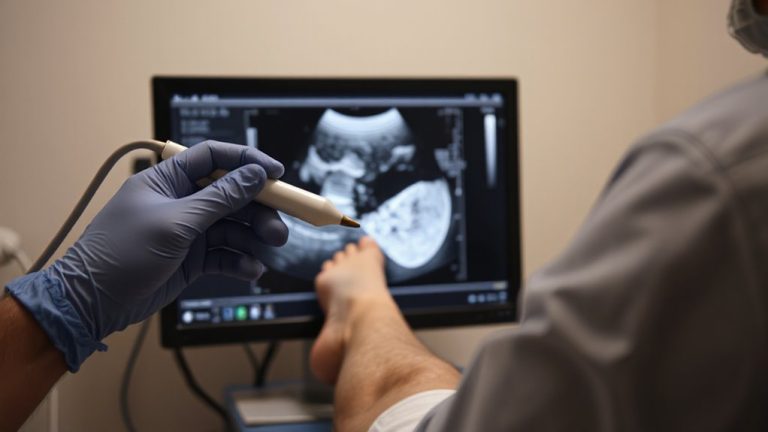
How do you know if your rehab program is truly addressing your specific ligament injury? It starts with accurate ligament identification-knowing exactly which ligament is damaged, its location, and the severity. Without this, treatment risks being generic and less effective. Advanced imaging and professional assessment guide this phase, ensuring therapy aligns with your anatomy. Once identified, goal setting becomes critical. Short-term objectives like reducing swelling and restoring range of motion lay the foundation, while long-term targets focus on strength and functional return. Personalized fitness recovery isn’t just about healing; it’s about smart progression. Generic fitness gear might not support your specific needs-customized braces or resistance tools often perform better. Evaluating your program’s effectiveness means checking whether milestones are met on time, symptoms improve, and movement gains are sustainable. Clarity in diagnosis and goals shapes a successful rehab trajectory.
Start Safe: Early Exercises for Ligament Healing
While healing begins the moment an injury occurs, your early exercise choices can either support or hinder the delicate repair process-especially with ligament damage, where too much stress too soon risks re-injury. You need to prioritize rest and controlled movement to avoid setbacks. Start with gentle range-of-motion exercises like ankle pumps or knee glides, which encourage blood flow without overloading healing tissue. Apply elevation during and after sessions to minimize swelling and support circulation. Avoid aggressive stretching or weight-bearing too early, as that compromises ligament integrity. Use supportive gear like compression wraps or adjustable braces to stabilize the joint without restricting safe motion. These tools, combined with rest and elevation, create a favorable environment for early healing. Progress slowly-you’re laying the foundation, not rushing recovery. Safety now prevents chronic instability later.
Build Strength and Joint Stability Gradually
Once the initial swelling has gone down and your range of motion starts improving, you’re ready to shift focus toward building strength and joint stability-this phase isn’t just about getting stronger, it’s about retraining the ligament and surrounding musculature to handle load safely. You’ll start with low-resistance exercises that emphasize muscle activation, ensuring key stabilizers fire correctly before progressing. Proper joint alignment during each movement is essential-missteps here can create imbalances or reinjury. Isometric holds, like wall squats or leg extensions, build neuromuscular control without stressing healing tissue. Resistance bands and body weight are ideal; they allow graded challenges without overloading. Consistency matters more than intensity at this stage. Quality repetitions with attention to form outweigh high volume. You’re laying the foundation for long-term joint integrity, so precision in every rep supports both recovery and future performance.
Add Dynamic Moves for Real-World Function
Why do some people breeze back into daily activities after ligament injuries while others struggle with simple tasks? It often comes down to how well they’ve trained for real-world demands. Once you’ve built baseline strength and joint stability, it’s time to integrate dynamic moves that mimic everyday actions-this is where functional movement shines. Think lunges with rotation, step-ups, or controlled jumps, all of which prepare your body for unpredictable motions. For athletes, adding sport specific drills-like lateral shuffles for soccer players or cutting drills for basketball-enhances neuromuscular coordination and joint resilience. These exercises aren’t just about intensity; they replicate the speed, direction changes, and load variations you’ll face outside rehab. Used correctly, fitness recovery tools like resistance bands or agility ladders can support this phase, helping refine control without overloading healing tissue.
Adjust Based on Pain and Progress
How do you know when to push forward or pull back in your rehab program? Listening to your body is key. Some discomfort is expected, but sharp or lingering pain means you’ve gone too far-this is where pain management becomes essential. Modify exercises immediately if pain spikes, using rest, ice, or compression as needed. At the same time, progress tracking helps you stay objective. Log reps, range of motion, and daily symptoms to see trends over time. Are you gaining mobility without flare-ups? That’s a sign to cautiously advance. But if progress stalls or pain increases, scaling back doesn’t mean failure-it’s smart adaptation. Your ligament needs consistent, controlled stress to heal, not overload. Balancing challenge with recovery guarantees steady gains. Adjusting based on pain and progress keeps your program effective, safe, and truly customized to your healing timeline. For added support during activity, consider incorporating compression sleeves into your routine to help manage swelling and improve proprioception.
Prevent Re-Injury With Smart Joint Protection
While healing your ligament is progress, protecting the joint long-term demands strategy beyond just rest and rehab. Smart joint protection hinges on two key tools: brace usage and activity pacing. A well-fitted, medical-grade brace stabilizes the joint during movement, reducing strain on healing ligaments-especially during dynamic tasks like walking on uneven terrain or light jogging. But relying solely on gear isn’t enough. You’ve got to pace your activity smartly, balancing effort with recovery to prevent overloading the joint. Think of it as building endurance without inviting setbacks. Gradually increase duration or intensity, monitor for swelling, and respect your body’s feedback. Combined, proper brace usage and disciplined activity pacing reduce re-injury risk markedly. They’re not shortcuts-they’re evidence-backed habits that support lasting recovery and keep you moving safely forward. For athletes returning to high-impact activities like volleyball, incorporating a supportive knee support can further enhance joint stability during dynamic movements.
On a final note
You’ve tailored your rehab to your ligament injury, progressing from gentle motions to dynamic stability work. This methodical approach builds strength and confidence, reducing re-injury risk. Quality recovery gear-like supportive braces and resistance bands-enhances performance when used correctly. Still, results depend on consistent, pain-guided adjustments. Overall, a customized program outperforms generic routines, offering targeted healing that adapts to real-world demands, making your comeback safer and more sustainable in the long term.