Best Back Exercises Bodybuilders Swear By
You build serious back strength with barbell rows, pull-ups, and deadlifts-they’re staples for a reason. These compound movements maximize muscle fiber recruitment while demanding spinal stability, especially under heavy load. A belt like the RDX Weight Lifting Belt AUTO LOCK supports your core with its tension-based roller buckle, enhancing intra-abdominal pressure without restricting movement. Proper form, full range of motion, and controlled eccentrics guarantee peak growth and joint health. Train twice weekly with progressive overload, and you’ll see measurable gains over time-consistency paired with the right gear delivers results most can’t ignore.
We are supported by our audience. When you purchase through links on our site, we may earn an affiliate commission, at no extra cost for you. Learn more. Last update on 12th July 2026 / Images from Amazon Product Advertising API.
Notable Insights
- Deadlifts are a cornerstone back exercise, building overall thickness and strength through heavy compound loading.
- Pull-ups maximize latissimus dorsi development and are favored for functional, bodyweight back training.
- Barbell rows promote dense mid-back mass and engage multiple muscles with controlled eccentric and full range of motion.
- Incline dumbbell rows isolate the lats more effectively by reducing momentum and increasing time under tension.
- Face pulls and reverse flyes enhance rear delt and scapular stability, improving posture and back symmetry.
RDX Weight Lifting Belt AUTO LOCK

If you’re serious about heavy lifting and need reliable lumbar support during intense back exercises, the RDX Weight Lifting Belt AUTO LOCK is one of the best choices on the market. I’ve used it through heavy deadlifts and squats, and the auto-lock closure never slips-its tension-based roller buckle stays secure under pressure. The long hook-and-loop strap guarantees a snug, unyielding fit, while the 6.5-inch contoured back support evenly distributes pressure. Made from durable nylon and polyester with reinforced stitching, it withstands constant use. The layered padding-Blacktop, EVA-Lution, and SpongEX-offers comfort without sacrificing stability, helping me brace harder and lift safer.
Best For: Lifters seeking a durable, secure-fitting weightlifting belt with superior lumbar support for heavy compound lifts like squats and deadlifts.
Pros:
- Auto-locking tension-based buckle ensures a secure fit and prevents accidental opening during intense workouts
- 6.5-inch contoured back support with multi-layer padding (Blacktop, EVA-Lution, SpongEX) enhances comfort and spinal stability
- Durable construction using nylon, polyester, and reinforced stitching withstands prolonged heavy use
Cons:
- Sizing requires precise waist measurement, which may lead to confusion if users rely on pant size
- Auto-lock mechanism may take time to adjust to for users accustomed to traditional double-prong belts
- Limited color options compared to some competitors despite multiple available styles
MANUEKLEAR Weight Lifting Belt for Women & Men
The MANUEKLEAR Weight Lifting Belt earns its place in any serious lifter’s recovery and performance toolkit, especially for those whose back exercises demand maximum core engagement and spinal protection. I’ve used it during heavy squats and deadlifts, and the support is immediate-firm compression around my waist boosts intra-abdominal pressure, stabilizing my spine. The breathable mesh keeps me cool, while the steel buckle locks securely without rusting. I appreciate the split design: narrow for moderate lifts, wide for max effort. It fits snugly, contours to my waist, and doesn’t slip. Whether I’m in the gym or traveling, it’s reliable, functional, and built to last.
Best For: Serious lifters seeking reliable core support and spinal protection during heavy squats, deadlifts, and intense training sessions.
Pros:
- Provides firm, adjustable support with a split belt design for customized fit and maximum stability
- Breathable mesh fabric and ergonomic shape ensure comfort and allow for extended wear
- Durable steel buckle and hook-and-loop closure offer secure fastening and resist rust and fading
Cons:
- May feel restrictive for users new to weight lifting or those preferring minimal support
- Fit might be less ideal for individuals with shorter torsos due to belt length
- Limited color options may not appeal to all aesthetic preferences
RDX Weight Lifting Belt AUTO LOCK

Since I’ve prioritized safety and stability during heavy compound lifts, the RDX Weight Lifting Belt AUTO LOCK stands out as an ideal choice for lifters who demand reliable support without compromising mobility. Its auto-locking mechanism and tension-based roller buckle keep the belt secure, eliminating accidental slippage. Made from polyester and nylon with reinforced stitching, it’s durable enough for daily grind. The 6.5-inch padded back, using Blacktop fabric and SpongEX, boosts spinal alignment and core bracing. I appreciate the ergonomic shape-it stays put during squats or deadlifts. Available in multiple colors, it blends style with function. I always size up when in doubt-it guarantees better comfort and performance.
Best For: Lifters seeking a secure, durable, and ergonomically designed weightlifting belt for heavy compound movements with reliable auto-locking support.
Pros:
- Features an auto-locking mechanism and tension-based roller buckle for a secure, slip-free fit during intense lifts
- Constructed from durable polyester and nylon with reinforced stitching for long-term resilience
- Ergonomic contoured design with 6.5-inch padded back support enhances spinal stability and comfort during squats and deadlifts
Cons:
- Auto-locking mechanism may take time to adjust to for users accustomed to traditional lever belts
- Limited breathability due to padded materials may cause discomfort during prolonged use
- Sizing accuracy is crucial; inconsistent measurements may affect fit despite recommending to size up
Factors to Consider When Choosing the Bodybuilding Best Back Exercises
You need to pick back exercises that match your goals, and that means paying close attention to muscle target precision-some moves hit the lats harder, while others emphasize the traps or lower back. Think about the exercise difficulty level and your current strength, because choosing movements too advanced or too basic can limit growth or lead to poor form. Also, check what equipment you have, since availability shapes your options, and always prioritize full range of motion and proper technique to get the most from each rep.
Muscle Target Precision
While many assume all back exercises deliver similar results, refining muscle target precision means adjusting key variables to isolate specific areas effectively. You’ll maximize latissimus dorsi activation with wide-grip pull-downs-EMG studies confirm they outperform narrow grips. When you control the eccentric phase, lasting 3–4 seconds, you boost neuromuscular recruitment, especially in deep stabilizers like the erector spinae. Keeping your scapulae fixed during rows increases mid-trap and rhomboid engagement, giving you cleaner, more focused stimulation. Prone movements such as reverse flyes target rear delts and lower traps with minimal crossover from larger muscles, making them ideal for balanced development. Grip width, torso angle, and tempo aren’t small details-they’re essential levers. You’re not just moving weight; you’re dictating which muscles earn the workload. Precision like this transforms good workouts into sculpted, functional gains.
Exercise Difficulty Level
How do you know when it’s time to advance from beginner rows to deadlifts or weighted pull-ups? You’re ready when your strength-to-bodyweight ratio improves, joint stability increases, and basic movements feel controlled. Beginners should start with bodyweight exercises like inverted rows to build neuromuscular coordination with low risk. As you gain confidence, shift to intermediate lifts-dumbbell rows or lat pulldowns-using moderate loads that challenge stability and range of motion. These build endurance and muscle growth safely. Advanced moves like deadlifts or weighted pull-ups demand high strength, core control, and technical precision. They’re more complex, requiring greater load intensity and stabilization than isolation moves. Don’t rush-advancing too soon raises injury risk. Match exercise difficulty to your actual mastery, not ego. Progressive overload works best when movement quality stays sharp.
Equipment Availability
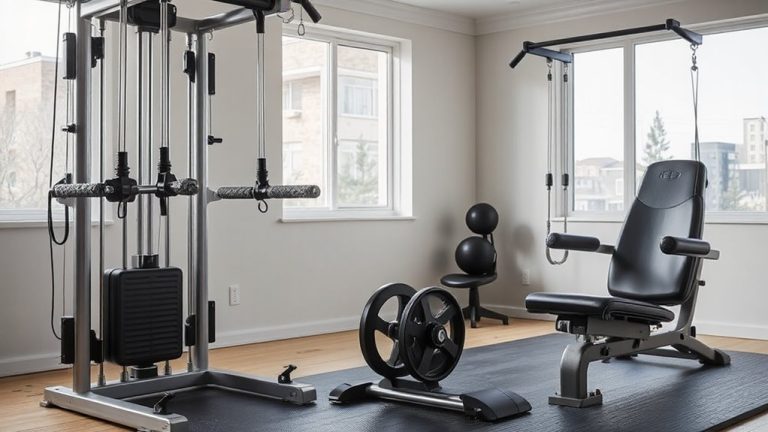
Equipment availability plays a defining role in shaping your back training roadmap, especially once foundational strength and movement control are established. If you’ve got free weights, you can tackle heavy compound moves like deadlifts and bent-over rows-essential for serious muscle growth. A power rack or squat stand? Even better. It lets you push limits safely with barbell rows and rack pulls, driving strength gains. Cable machines or resistance bands open doors to precise isolation work-think lat pulldowns or face pulls-that sharpens muscle activation and fixes imbalances. An adjustable bench expands your options further, allowing seated cable rows or incline dumbbell rows for targeted engagement. Without much gear, you’re not out of luck. Pull-ups and hyperextensions still deliver solid results when done consistently. You don’t need a full gym, but the right equipment definitely amplifies progress.
Range Of Motion
What if the key to accessing serious back development isn’t just lifting heavier, but moving smarter? You maximize muscle fiber recruitment by using a full range of motion, directly boosting hypertrophy and long-term strength. When you lower weights slowly and rise completely, you increase time under tension-especially during the eccentric phase-sparking greater neuromuscular adaptation. Full movement patterns also enhance joint flexibility and coordination across the spine and scapulae, helping prevent imbalances. Skimping on range reduces activation in major muscles like your lats and erector spinae, weakening the exercise’s impact. Controlled, complete reps guarantee balanced growth, lowering your risk of posture issues and overuse injuries. You’re not just moving weight-you’re building a resilient, well-proportioned back. Smart motion beats sheer load every time.
Form And Technique
A well-aligned spine isn’t just a suggestion-it’s your foundation for safe, effective back development. Keep your natural spinal curvature during deadlifts and rows to reduce disc herniation risk. When you row, avoid rounding your lower back; excessive torso flexion increases lumbar shear forces, especially under heavy loads. Instead, brace your core and maintain a neutral spine. Engage your scapular stabilizers early-initiate movements like seated cable rows by retracting your shoulder blades. This boosts rhomboid and lower trapezius activation by up to 35% while minimizing biceps compensation. Control the eccentric phase: lowering over 2–3 seconds increases time under tension, driving hypertrophy and improving neuromuscular control. Don’t rush-quality reps beat speed. Proper technique isn’t just about injury prevention; it guarantees you’re working the right muscles efficiently, maximizing growth and strength gains with every set.
Workout Frequency
Now that you’ve mastered proper form and understand how to protect your spine while maximizing muscle engagement, it’s time to contemplate how often you should be training your back for the best results. Training your back 2 to 3 times per week strikes a balance between sufficient stimulus for hypertrophy and adequate recovery. Research supports at least 48 hours of rest between intense sessions to optimize muscle protein synthesis and prevent overtraining. If you’re handling volume well and recovery is solid, three sessions may boost strength gains more than two. But your actual frequency should reflect individual recovery capacity-factors like sleep quality, nutrition, and overall training intensity directly impact how quickly muscles rebuild. Beginners often make great progress training twice weekly, lowering injury risk and soreness. Ultimately, consistency and recovery matter more than frequency alone; listen to your body and adjust based on performance and fatigue.
Progressive Overload Strategy
Because muscle growth hinges on continuous adaptation, you need to systematically push beyond your limits over time-this is where progressive overload becomes essential. You must gradually increase weight, reps, or frequency to keep challenging your back muscles and drive hypertrophy. Research shows that boosting intensity by 2.5–5% weekly optimizes strength and muscle gains. Track your workout volume-sets × reps × load-and aim for steady increases across cycles. Since muscle protein synthesis stays elevated up to 48 hours post-training, strategic progression during recovery enhances growth. Always adjust just one variable at a time-load, volume, or frequency-to maintain proper form and reduce injury risk. This disciplined, measurable approach guarantees continued progress while keeping your back development targeted and effective. Progressive overload isn’t just about lifting heavier-it’s about smarter, sustainable advancement that aligns with your body’s adaptive capacity.
Frequently Asked Questions
What Muscles Do Back Exercises Primarily Target?
You primarily target your latissimus dorsi, rhomboids, trapezius, and erector spinae with back exercises. These muscles support posture, strength, and upper-body movement. You engage the lats during pulls, the traps and rhomboids in scapular retraction, and the erectors in stabilization. Compound movements like rows and pull-ups activate multiple groups efficiently. Proper form guarantees balanced development and reduces injury risk. Recovery aids like foam rollers and quality fitness gear help maintain muscle health and performance over time.
How Often Should I Train My Back?
You should train your back 2–3 times per week, allowing at least 48 hours of recovery between sessions. This frequency balances muscle stimulation with adequate repair, essential for growth and strength. Overtraining hinders progress, especially without proper recovery gear like compression shirts or foam rollers. These tools aid circulation and reduce soreness, letting you maintain consistency. Always assess fatigue-quality beats quantity when building a strong, resilient back.
Can Back Exercises Improve Posture?
Yes, back exercises can improve your posture by strengthening the muscles that support spinal alignment. When you train your upper and lower back consistently, you reduce rounding of the shoulders and forward head position. Exercises like rows and face pulls enhance scapular stability, which helps maintain an upright posture. Over time, this muscular balance counters the effects of sitting and promotes better daily alignment without strain.
Are Free Weights Better Than Machines for Back Workouts?
You’ll get better back development using free weights because they engage stabilizer muscles and mimic real-world movement. Machines offer stability and isolate muscles well, but limit functional strength gains. Free weights demand control and balance, enhancing neuromuscular coordination. If you’re building strength and muscle efficiently, dumbbells and barbells give you more bang for your buck. Just maintain proper form to avoid injury. Machines? Great for rehab or adding volume.
Should I Do Cardio Before or After Back Exercises?
You should do cardio after back exercises, not before. Lifting heavy first preserves your strength and focus for compound movements like deadlift游戏副本