Best Back Machines for a Stronger, Healthier Spine
You’ll build a stronger, healthier spine with machines that support proper alignment and reduce shear stress. Try the Mikolo Linear Row Machine for smooth, guided motion that protects your lower back while targeting lats and rhomboids. The Sunny Health Hyperextension Bench strengthens posterior chains with a stable, foldable design. Inversion tables like the Innova model offer spinal decompression with heat therapy. High weight capacities and adjustable pads improve fit and safety-smart choices pay off in long-term form and function, and there’s more to discover about optimizing your setup.
We are supported by our audience. When you purchase through links on our site, we may earn an affiliate commission, at no extra cost for you. Learn more. Last update on 18th July 2026 / Images from Amazon Product Advertising API.
Notable Insights
- Choose machines with guided motion to support spinal alignment and reduce injury risk during back exercises.
- Prioritize equipment with high weight capacity, such as the 660 lb-rated GHPower Hyperextension Bench, for safety and durability.
- Use adjustable seats and pads to ensure proper form and accommodate various body types for spine-healthy training.
- Opt for devices like the Mikolo Linear Row Machine that minimize lower back strain with smooth, controlled movement paths.
- Incorporate inversion tables like the Innova Advanced model to decompress the spine and promote long-term spinal health.
Sunny Health Foldable Hyperextension Bench
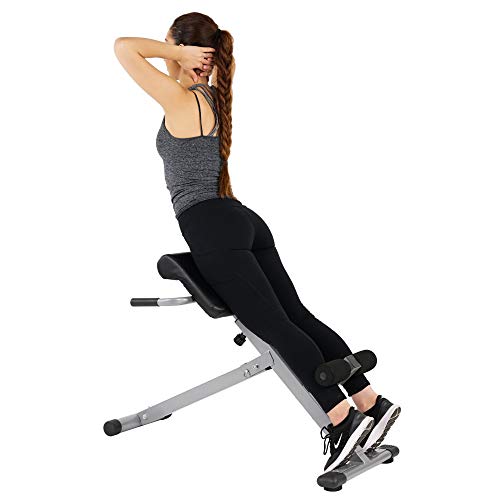
If you’re someone who values spine-friendly strength training without compromising on space or durability, then the Sunny Health Foldable Hyperextension Bench is an excellent pick. I’ve used it for glute, ab, and lower back workouts, and it delivers solid performance. Its heavy-duty steel frame feels stable, and the non-slip handles keep me secure. The high-density foam pads cushion my hips and legs comfortably, even during long sets. At 250 pounds max capacity, it suits most users, and folding it takes seconds-perfect for tight spaces. At 24 pounds, it’s light but sturdy. Assembly was quick, and the included manual helped. For home fitness, this bench offers reliable, multifunctional training without sacrificing quality.
Best For: Home fitness enthusiasts seeking a durable, space-saving solution for spine-friendly glute, abdominal, and lower back workouts.
Pros:
- Heavy-duty steel frame and non-slip handles provide stability and safety during intense workouts
- High-density foam padding ensures comfort for hips and legs even during extended use
- Foldable design and lightweight build make it easy to store and move in small spaces
Cons:
- Maximum weight capacity of 250 pounds may not accommodate heavier users
- Limited adjustability in height settings compared to premium models
- Assembly required, though generally quick and straightforward
Seated Row Machine 400LBS Capacity

The Seated Row Machine 400LBS Capacity stands out as a top-tier choice for fitness enthusiasts who prioritize spine health without sacrificing strength-building potential. I’ve found its fixed path of motion delivers consistent resistance, enhancing lat, rhomboid, and trap activation better than cable rows. The dual grip system-rotating and fixed-supports natural arm movement while allowing precise targeting, similar to barbell rows. With adjustable seat and chest pad, plus independent diverging arms, it fits various body types and training styles. Built from heavy-duty steel and coated for durability, it holds up to 400 lbs and fits neatly in small spaces at 63.7”x28.7”x42.2”. It’s reliable, efficient, and backed by 24/7 support.
Best For: Strength trainers and home gym users seeking a durable, space-efficient seated row machine that supports proper spinal alignment and versatile back workouts.
Pros:
- Targets key back muscles (lats, rhomboids, traps) with enhanced activation through fixed-path motion and dual grip options
- Adjustable seat, chest pad, and independent diverging arms accommodate various body types and training styles
- Heavy-duty steel frame with advanced coating supports up to 400 lbs and fits compact spaces at 63.7”x28.7”x42.2”
Cons:
- Weight plates not included, requiring additional purchase for full functionality
- Fixed path of motion may limit advanced lifters seeking free-form movement
- High durability features may exceed needs of casual users, impacting cost-effectiveness
Innova Advanced Heat and Massage Inversion Table

I’ve found the Innova Advanced Heat and Massage Inversion Table especially beneficial for individuals seeking targeted spinal relief combined with customizable therapy options, making it a standout choice among back machines designed for spine health. Its patent-pending vertical massage pad covers the full spine, while the contoured lumbar pad focuses on lower back tension. I appreciate the multi-mode heat and massage settings, offering both auto and manual control. The six-position pin system adjusts easily for users from 4’10” to 6’6″ and includes protective covers for safety. With a 300 lb capacity and improved ankle supports-featuring front and rear holders-it reduces pressure during inversion. The strap systems add stability, and at 46″ H × 28″ W × 61″ D, it’s compact enough for home use without sacrificing durability or function.
Best For: Individuals seeking targeted spinal and lower back relief with customizable heat and massage therapy in a durable, adjustable inversion table for home use.
Pros:
- Patent-pending vertical massage pad with contoured lumbar support delivers full-spine coverage and focused lower back therapy
- Six-position adjustable pin system with protective cover accommodates users from 4’10” to 6’6″ and enhances safety during inversion
- Multi-mode heat and massage settings with auto and manual controls, plus ergonomic ankle supports and 300 lb capacity for comfort and stability
Cons:
- Assembly required may be time-consuming for some users
- Limited portability due to size and weight despite home-friendly dimensions
- Advanced features may be overwhelming for beginners new to inversion therapy
Mikolo Linear Row Machine for Home Gym

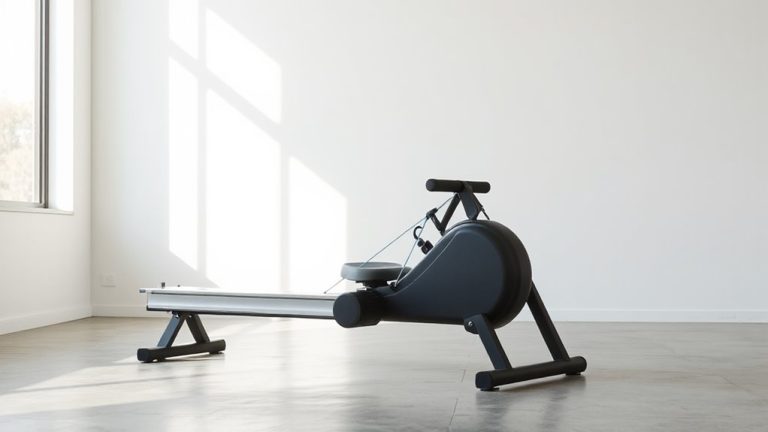
You’ll appreciate the Mikolo Linear Row Machine if you’re serious about building back strength without compromising spinal health-especially in a home gym where space and safety are priorities. I’ve found its linear path motion considerably reduces lower back strain, letting me target lats, traps, and rhomboids safely. The fixed track with linear bearings eliminates wobble, so my reps stay smooth and controlled. It fits neatly in just 5.8 sq.ft., perfect for tight spaces. Better packaging also meant mine arrived fully protected, no damage. Whether you’re new or advanced, the guided movement improves form and supports heavy loading while keeping you stable-ideal for consistent, spine-friendly training.
Best For: Home gym users seeking a spine-friendly, space-efficient rowing machine that supports proper form and heavy loading for effective back training.
Pros:
- Ergonomic linear path motion reduces lower back strain and promotes safe, targeted back muscle activation
- Stable fixed track with linear bearings ensures smooth, wobble-free repetitions and consistent form
- Compact 5.8 sq.ft. footprint makes it ideal for home gyms with limited space
Cons:
- Fixed track limits movement variability, potentially reducing functional strength carryover
- Advanced lifters may find adjustability options limited compared to free-weight alternatives
- Higher initial cost compared to basic cable or resistance band rowing setups
Sunny Health Foldable Hyperextension Bench

A standout choice for home fitness enthusiasts focused on spinal support and functional strength is the Sunny Health Foldable Hyperextension Bench, especially for those who need versatility without sacrificing space or performance. I’ve found it excels in multi-functional training-supporting hyperextensions, lumbar stretches, and core work, plus built-in dip bars for upper-body gains. With three incline levels and ten height settings, it adapts well to different bodies and intensity levels. The high-density foam padding guarantees comfort, and the 330 lb capacity reflects solid build quality. Its foldable frame and wheels make storage effortless, while the SunnyFit App adds real value with guided workouts.
Best For: Home fitness enthusiasts seeking a versatile, space-saving solution for spinal support, core strength, and full-body workouts.
Pros:
- Multi-functional design supports hyperextensions, lumbar stretches, dips, and core exercises
- Adjustable incline and height settings ensure customized fit and workout intensity
- Foldable frame with wheels and app integration for convenient storage and guided training
Cons:
- Assembly can be time-consuming and may require two people
- Dip bars may feel narrow for users with broader shoulders
- App content, while helpful, is primarily beginner to intermediate level
FF Finer Form Adjustable Weight Bench

Though not a dedicated back machine, the FF Finer Form Adjustable Weight Bench stands out as an excellent choice for those aiming to support spine health through controlled, low-impact strengthening exercises-especially if you value versatility and space efficiency in a home gym. I use it for back extensions, hyperextensions, and core work, all of which stabilize my spine. Its high-grade steel frame feels rock-solid, supporting up to 660 lbs, while the thick padding keeps me comfortable during reps. It assembles in about 30 minutes and replaces several bulky machines. The included workout chart guides proper form, and its compact design saves serious floor space-perfect for effective, joint-friendly training.
Best For: Home fitness enthusiasts seeking a versatile, space-saving bench for full-body workouts including spine-supporting core and back exercises.
Pros:
- Supports up to 660 lbs with a durable high-grade steel frame for intense, secure workouts
- Multi-functional design replaces multiple machines, enabling bench press, back extensions, sit-ups, and more
- Compact, adjustable build with thick padding and a free workout chart for guided, joint-friendly training
Cons:
- Not a dedicated back machine, so advanced back-specific features may be limited
- Assembly required, which may be challenging for some users despite 30-minute estimate
- Limited color options available (only black and red)
Mikolo Seated Row Machine 400LB Capacity
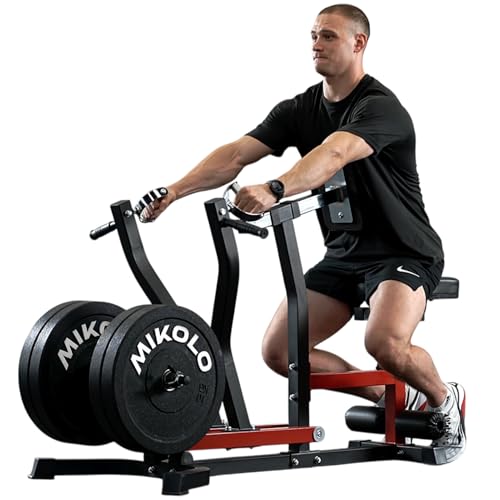
Since I prioritize both spinal alignment and controlled muscle engagement during back training, the Mikolo Seated Row Machine 400LB Capacity stands out as an ideal choice for home users serious about spine health and structured strength development. Its fixed movement path isolates lats, rhomboids, and traps with precision, while the inclined seat promotes a full range of motion without compromising form. I appreciate the dual handles-rotating for high-rep comfort, fixed for heavy T-bar-like pulls-and the independent arms, which help correct imbalances. Built tough with a 400LB capacity and corrosion-resistant steel, it’s stable, durable, and fits neatly in small spaces. The included 1” and 2” adapters make plate changes easy, and 24/7 support guarantees setup is hassle-free.
Best For: Home and office gym users seeking a durable, biomechanically sound seated row machine that supports spinal alignment and targeted back muscle development.
Pros:
- Fixed movement path and inclined seat promote proper form, spinal alignment, and full range of motion for effective back training
- Dual handle system and independent arms allow for ergonomic variety, unilateral training, and correction of muscle imbalances
- Heavy-duty 400LB capacity frame with corrosion-resistant finish, compact footprint, and inclusive 1”/2” plate adapters for versatile, space-efficient use
Cons:
- Requires separate weight plates, not included with purchase
- Limited padding adjustability may not suit all body types without fine-tuning
- High-rep use may reveal minor seat cushion firmness limitations over time
GDLF LAT Pull Down Machine

You’ll want the GDLF LAT Pull Down Machine if your routine demands precise upper back development without compromising spinal alignment, especially when performing high-resistance lat pulldowns that challenge both form and stability. I’ve found its dual pulley system lets me switch smoothly between high and low exercises, targeting my lats, traps, and rear delts efficiently. The 4-position seat and foam rollers keep me locked in, so I don’t arch or lift under heavy load. That stability means I train harder while protecting my spine. Adjustable and well-built, it supports functional pulling motions that mimic real strength demands, making it a smart pick for serious, spine-conscious lifters.
Best For: Serious lifters focused on precise upper back development while maintaining proper spinal alignment during high-resistance pulling exercises.
Pros:
- Dual pulley system enables versatile training with both high and low pulley exercises for comprehensive upper body development
- 4-position seat and foam rollers ensure secure, stable positioning to maintain proper form under heavy loads
- Supports functional movement patterns that engage lats, traps, rear delts, and scapular stabilizers effectively
Cons:
- Limited lower body exercise functionality, restricting full-body workout integration
- Foam rollers may feel restrictive for users with broader frames or limited mobility
- Requires adequate overhead clearance and floor space due to dual pulley structure
Roman Chair Hyperextension Bench for Home Gym

The Roman Chair Hyperextension Bench from FITKS360 stands out for those who prioritize spinal integrity while building posterior chain strength at home, especially if space and long-term durability are real concerns. I’ve found its 45° angle optimizes hamstring and glute activation while minimizing lower back strain. At just 23 lbs, it’s light but built tough with a steel frame and reinforced padding, and it folds down to 25 x 15 x 7 inches-perfect for compact spaces. It supports users up to 330 lbs, fitting most adults between 5 and 6 feet. With a lifetime warranty and simple assembly, it’s a smart, lasting pick for serious home training.
Best For: Home gym users seeking a durable, space-saving hyperextension bench that supports spinal health and targets the posterior chain effectively.
Pros:
- 45° hyperextension angle enhances muscle activation while protecting the lower back
- Foldable design with compact storage dimensions (25 x 15 x 7 inches) ideal for small spaces
- Lifetime warranty and sturdy steel frame support up to 330 lbs for long-term durability
Cons:
- Height range limited to 5–6 feet, potentially excluding taller or shorter users
- Maximum weight capacity of 330 lbs may not accommodate all users
- Minimal adjustability beyond basic frame positioning for personalized fit
GMWD AB/Back Workout Machine

When space and efficiency matter just as much as effective core training, the GMWD AB/Back Workout Machine stands out as a smart choice for home gym users and spine-conscious lifters alike. I’ve found its dual-function design eliminates the need for two separate units, saving floor space without sacrificing training variety. The pop-pin system makes switching between ab and back exercises quick, while the rotary flywheel guarantees smooth, controlled movement. With 27 adjustment points, I can fine-tune the range of motion to match my flexibility and strength. Adjustable foot restraints and a padded, height-adjustable seat keep me stable and comfortable, no matter my height. It’s a practical, durable solution for consistent core development.
Best For: Home gym users and spine-conscious lifters seeking a space-efficient, dual-function machine for comprehensive core training.
Pros:
- Combines ab and back extension exercises in one compact unit, maximizing space and minimizing equipment costs
- Offers 27 range-of-motion adjustments and an 8-position foot restraint system for precise customization and user comfort
- Features a padded, height-adjustable seat and durable construction to support users of various statures and promote long-term use
Cons:
- Limited to core-specific training, lacking functionality for full-body or limb-focused workouts
- Assembly may be time-consuming due to multiple adjustable components and mechanisms
- Higher price point compared to basic ab benches, potentially limiting accessibility for budget-focused buyers
Factors to Consider When Choosing a Back Machine
You’ll want to check the weight capacity first-skimping here could mean unsafe workouts or a machine that doesn’t suit your long-term goals. Adjustability and fit directly affect your form, so look for options that accommodate your height and range of motion without compromising muscle target focus. Don’t overlook build quality or storage needs, since a sturdy frame lasts longer and a compact design fits better in most home gyms.
Weight Capacity Limits
A solid back machine handles more than just your workout-it must safely manage both your body weight and the resistance you add, with most models supporting a combined load between 250 and 660 pounds. You’ll want to confirm both your body weight and the extra load from weights, since exceeding the limit risks structural failure and injury. Machines built for higher capacities usually feature reinforced steel frames and better stability, making them safer for intense moves like weighted hyperextensions or heavy seated rows. Don’t assume the max weight includes just you or just the plates-specs typically cover the total load. That means if you weigh 200 pounds and add 100 pounds of resistance, your machine must support at least 300 pounds. Choosing one with a comfortable margin above your needs guarantees durability and safety over time, especially with long-term or frequent use.
Adjustability And Fit
Though often overlooked, adjustability directly impacts how well a back machine aligns with your body and movement patterns, making it a crucial factor in both performance and safety. You need an adjustable seat with at least four height positions to maintain proper spinal alignment, no matter your stature. Look for foot restraints that offer over five inches of adjustment-this guarantees a secure setup and better leverage across different leg lengths. Customizable pad placements help you accommodate your torso and limb proportions, improving exercise effectiveness. Machines with adjustable resistance paths or arm angles let you fine-tune the movement to reduce joint strain and boost comfort. These features aren’t just convenient-they’re essential for long-term spine health. When you choose a machine with thorough adjustability, you’re not just buying equipment; you’re investing in a safer, more effective workout tailored to your body.
Muscle Target Focus
Precision in muscle engagement starts with the design of the back machine itself, and that’s where muscle target focus becomes non-negotiable. You get precise activation when fixed movement paths guide your motion, isolating lats, rhomboids, and traps through consistent ranges. Adjustable grip widths and dual handles let you shift emphasis across muscle regions, boosting both engagement and versatility. If you want full contractions, look for inclined seating or angled positioning-it optimizes the line of pull and increases range of motion. Machines with independent arm movement are ideal for correcting imbalances and sharpening your mind-muscle connection during unilateral work. Dual pulley systems with high and low stations open up pulling angles, letting you train multiple back areas across varied movement patterns. These features don’t just add variety-they guarantee thorough, functional back development tailored to your body’s needs.
Build Quality Matters
You need a machine that won’t buckle under heavy loads or degrade after months of consistent use, and that starts with a heavy-duty steel frame rated for at least 300 pounds-this isn’t just about strength, it’s about sustained safety and performance. Choose models with high-density foam padding and reinforced cushions; they resist compression and keep supporting your spine over time. Non-slip handlebars and a stable base, especially those with triangular support, cut down on wobbling during intense sets. Look for corrosion-resistant coatings-they shield the frame from moisture and wear, making the machine last longer, especially in humid environments. Linear bearings and fixed track systems aren’t just about smooth motion; they stabilize movement, reducing stress on joints and ensuring consistent alignment. These features don’t just promise durability-they deliver reliable, safe workouts every time.
Space And Storage
A well-built back machine stands up to daily use, but even the most durable model won’t fit into your routine if it doesn’t fit into your space. You need to check the assembled dimensions-footprints range from under 6 sq.ft. to over 35 sq.ft., so small home gyms demand compact options. Foldable designs cut storage space by up to 60%, tucking neatly into closets or corners. If you move the machine often, look for built-in wheels or lightweight builds; they make shifting it much easier. Tall models, like inversion tables, require over 6 feet of vertical clearance-check ceiling height before buying. Also, consider packaged size and weight: some units exceed 40 inches and 40 pounds, complicating storage in tight areas or when lifting overhead. Smart space planning guarantees your back machine stays accessible, safe, and ready when you need it.
Ease Of Assembly
Putting together your back machine shouldn’t feel like solving a puzzle blindfolded. If you choose a model with fewer than 20 components, you’ll likely finish assembly in under 30 minutes. Machines with over 50 parts, though sturdier, can take up to two hours. Look for pre-assembled subunits and modular designs-they cut setup time and reduce frustration. Clear, step-by-step manuals with labeled diagrams help, especially when they include QR codes linking to video tutorials. These features boost success rates and make the process smoother. Most setups require basic tools like adjustable wrenches and Allen keys, so check if the hardware kit is included. You’ll also find assembly easier with lightweight alloy steel or aluminum frames-these are simpler to maneuver than heavy solid steel ones. Smart design and user-focused details make all the difference.
Frequently Asked Questions
How Often Should I Use a Back Machine for Best Results?
You should use a back machine 3 to 4 times per week for best results, letting your muscles recover on off days. Overtraining increases injury risk, while consistent, spaced sessions build strength safely. Pair machine work with free weights and core exercises to enhance stability. Always warm up first, maintain proper form, and adjust resistance gradually. Clean the machine after each use, and check cables and padding regularly to guarantee peak performance and longevity.
Can Back Machines Help With Sciatica Pain Relief?
Yes, you can find some relief from sciatica pain with back machines, especially those promoting spinal decompression or controlled lumbar support. Devices like inversion tables or seated spinal stretchers help reduce nerve compression, but they’re not instant fixes. You’ll need consistent, moderate use alongside professional medical advice. Overreliance or improper use might worsen symptoms, so always prioritize correct form and consult a specialist to match the machine to your specific condition.
Are Inversion Tables Safe for People With High Blood Pressure?
you shouldn’t use inversion tables if you have high blood pressure-they can spike your blood pressure further and risk complications like stroke or eye strain. the inverted position increases pressure in your head and circulatory system, which is dangerous when your blood pressure’s already elevated. doctors usually advise against it. safer recovery tools include low-impact stretching devices or decompression belts that don’t compromise cardiovascular stability while still supporting spinal health.
Do Hyperextension Benches Build Muscle or Just Improve Flexibility?
You build muscle with hyperextension benches, not just improve flexibility. The movement targets your lower back, glutes, and hamstrings through controlled eccentric and concentric contractions. When you add resistance or increase reps, you stimulate hypertrophy. While some mobility benefits exist, the primary function is strength development. Proper form keeps stress on the right muscles, making it a functional choice for core stability and spinal support in fitness routines.
Can I Use Back Machines After Spinal Surgery?
You shouldn’t use back machines right after spinal surgery-you’ll need clearance from your doctor first. Early recovery relies on controlled, low-impact movements, not loaded resistance. Once healed, machines like seated rows or back extenders can help rebuild strength safely, if used with proper form and light resistance. Always start slow, monitor pain responses, and prioritize spinal alignment. Physical therapy often guides reintroduction, making it safer and more effective long-term.