Prehabilitation Exercises for Preventing Ankle Sprains in Basketball Players
You should focus on ankle prehab that combines mobility, strength, and neuromuscular control to cut sprain risk, especially if you’ve had prior injuries. Ankle circles, banded toe walks, and heel raises boost joint motion and muscle activation. Single-leg stands and wobble board drills sharpen balance. Strengthen calves, shins, and foot muscles to support dynamic landings. Train soft, controlled landings with proper alignment and reactive agility for game-speed resilience-there’s a smarter way to stay on the court.
Notable Insights
- Perform ankle circles daily to improve dorsiflexion and joint lubrication for greater mobility.
- Activate stabilizing muscles using banded toe walks and heel raises before practice.
- Enhance proprioception with single-leg stands and wobble board drills to boost balance and reaction time.
- Strengthen calves, shins, and foot muscles to support dynamic stability during cuts and jumps.
- Train soft, controlled landings with knees bent and feet shoulder-width apart to reduce sprain risk.
Prioritize Ankle Prehab to Stay in the Game
While you might not think about it until after a twist turns into a full-blown sprain, prehabbing your ankles now can keep you moving when others are benched. If you have a prior injury history, your risk of re-injury jumps considerably-research shows up to 70% of ankle sprains occur in those with previous damage. That’s where consistent prehab comes in. Ankle taping isn’t just for game day; when combined with structured exercises, it offers short-term support while you build long-term resilience. However, relying solely on taping can create dependency, weakening natural stabilizers over time. Smart prehab strategies beat passive gear alone. You’re not just protecting tissue-you’re retraining neuromuscular control. Think of prehab as performance insurance: lightweight, cost-effective, and critical for athletes who can’t afford downtime. Your ankles take constant stress; make sure they’re ready before the next cut or jump demands perfection.
Improve Ankle Mobility and Activate Key Muscles
Ankle mobility isn’t just about flexibility-it’s the foundation of stability and power transfer during movement. You need full range of motion to cut, jump, and land safely on the court. Start with ankle circles-10 slow clockwise and counterclockwise rotations per foot-to lubricate the joint and improve dorsiflexion. This simple drill boosts circulation and primes the ankle for dynamic action. Pair it with muscle activation exercises like banded toe walks and heel raises to wake up the tibialis anterior, peroneals, and calf complex. These guarantee your muscles fire quickly during sudden shifts in direction. Proper activation reduces reliance on passive structures like ligaments, lowering sprain risk. Skipping this phase means relying on momentum, not control. Consistent ankle circles and muscle activation build resilient mechanics. It’s not flashy gear or expensive braces-it’s smart prep. Do it daily, especially pre-practice, and you’ll move with sharper precision and confidence on game day.
Boost Balance With Proprioception Drills
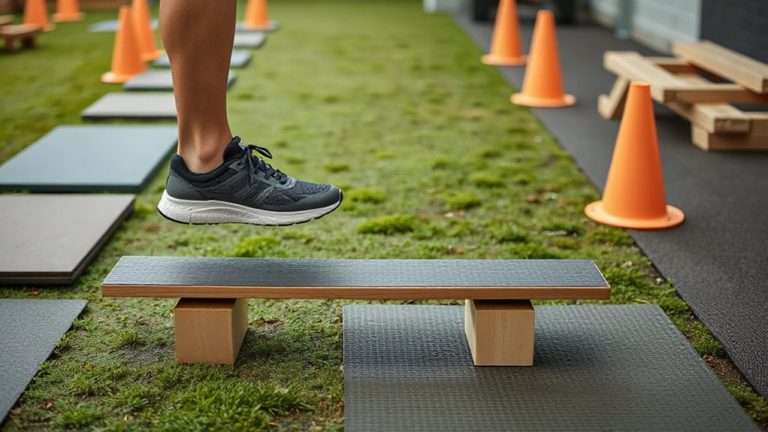
Why do some athletes roll their ankles and walk it off, while others suffer repeated sprains from the same move? The difference often comes down to joint awareness and neural feedback. Proprioception drills train your body to sense joint position and react instantly to shifts in balance. Simple moves like single-leg stands, wobble board routines, or tandem walking challenge your system under controlled conditions. These exercises boost communication between your muscles and nervous system, sharpening responses during fast cuts on the court. You’re not just improving balance-you’re building smarter movement patterns. Over time, consistent drills enhance stability by reinforcing accurate neural feedback loops. That means when your ankle starts to give way, your body’s already primed to correct it. It’s preventive tech built into your physiology. For basketball players, this kind of prehab is non-negotiable.
Strengthen Calf, Shin, and Foot Muscles
Because stability doesn’t come from ligaments alone, you’ll need to build real strength in the muscles that support your ankle-especially those in the calf, shin, and foot. Strong calves enhance calf endurance, helping you push off and absorb impact during cuts and jumps. Neglect them, and you’re more likely to fatigue early, increasing injury risk. Your tibialis anterior, the main shin muscle, controls foot drop and contributes directly to foot stability, especially on uneven surfaces. Weakness here can lead to tripping or poor landing mechanics. Small intrinsic foot muscles also play a key role-they fine-tune balance and reinforce arch support. Exercises like heel raises, toe walks, and resistance band dorsiflexions target these areas effectively. Consistent training improves not just muscle capacity but coordination under load. Use proper form and gradually increase volume to guarantee long-term gains. When paired with proprioception work, this muscular foundation becomes a critical part of your prehab strategy.
Land Safely to Avoid Sprains
You’ve built strength in your calf, shin, and foot muscles, which gives you a solid base, but that strength needs to be applied effectively when your foot hits the ground. Proper jump technique isn’t just about height-it’s about control. You must land with soft knees, hips back, and feet shoulder-width apart to absorb impact evenly. Poor landing mechanics increase ankle sprain risk, especially when fatigue sets in late in the game. Train yourself to land quietly; loud thuds mean force isn’t being managed well. Focus on alignment: knees over toes, not caving inward. This isn’t just form-it’s injury prevention. Even with great strength and supportive gear, sloppy landings undo progress. Consistent practice of proper jump technique conditions your body to default to safe mechanics. Over time, this becomes automatic, protecting your ankles when reactions matter most.
Train Agility for Game-Speed Protection
How often do you actually mimic the chaos of game speed in your training? Real basketball demands sharp bursts, sudden stops, and the ability to change direction under pressure. That’s why agility drills must go beyond scripted ladders and cones in straight lines. You need unpredictable patterns that force reactive cuts-responding to visual or auditory cues-so your ankles adapt to real defensive slides, fast breaks, and off-balance landings. This kind of training builds neuromuscular control, priming your body to stabilize instantly when you pivot hard. Studies show athletes who include reactive agility work reduce ankle sprain risk by enhancing dynamic joint stability. Equipment like agility mirrors or partner-directed drills add variability without needing high-tech gear. Consistently training these movement patterns conditions ligaments and muscles to handle stress, not just in isolation, but exactly how they’ll be tested during play-fast, unpredictable, and unforgiving.
Build Your Weekly Ankle Prehab Routine
Where do most athletes go wrong in their prehab routines? They skip consistency or rely solely on ankle bracing and tape support without building intrinsic strength. You need a balanced weekly plan that combines mobility, stability, and neuromuscular control to truly protect your ankles.
| Day | Exercise | Notes |
|---|---|---|
| Monday | Banded ankle dorsiflexion | 3 sets of 15 reps per side |
| Wednesday | Single-leg balance reach | Use on unstable surface |
| Friday | Calf raise control | Slow eccentric phase |
| Saturday | Agility ladder drills | Enhances foot speed and timing |
| Sunday | Rest or light foam rolling | Promotes recovery |
Ankle bracing helps, but it’s no substitute for strength. Tape support offers short-term stability, but overuse may limit proprioception. Build resilience through targeted exercises so you rely less on external aids and more on your body’s natural defenses.
On a final note
You’ve got the tools to cut ankle sprain risks with targeted prehab. Strengthening calves, shins, and foot muscles boosts stability, while proprioception drills sharpen balance. Proper landing mechanics and agility work translate gains to real-game demands. Consistent weekly routines enhance resilience, especially with supportive gear like compression sleeves or ankle braces aiding recovery. Investing in mobility and strength pays off in fewer injuries and sharper performance-making prehab not just smart, but essential.